



Bright Kiddo Bilingual Preschool and Nursery
Bilingualism
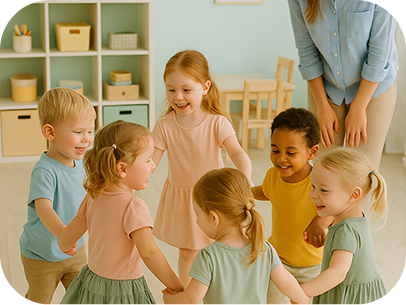
Bright Kiddo Bilingual Preschool and Nursery – Natural Bilingualism for the Youngest

Why is it so important for your child’s development?
Supports cognitive development and mental flexibility
Bilingual children develop better concentration, attention shifting ability, and problem-solving skills, which positively impacts their overall intellectual development.
Teaches the conscious use of two languages
The child develops the ability to distinguish and use two languages fluently, which supports his or her communication and allows him or her to react more consciously in various situations.
Strengthens social skills and empathy
Bilingualism makes it easier for children to establish relationships with peers and adults from different cultures, which develops their openness, tolerance and ability to cooperate.
Builds self-confidence in communication
Children learn to express their thoughts and emotions in two languages, which increases their self-confidence and ability to adapt to diverse environments.
Develops memory and listening skills
Regular use of two languages trains working memory and phonological hearing, which is crucial for learning to read and write.
Enriches cultural and social experiences
Bilingual upbringing exposes children to a diversity of cultures, traditions and ways of thinking, which broadens their horizons and supports comprehensive development.
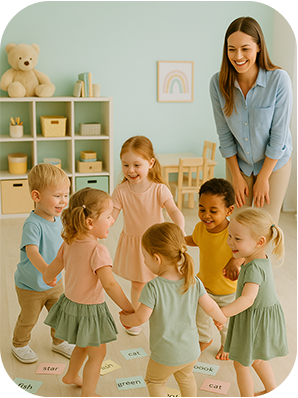
What makes bilingualism unique at Bright Kiddo?
We create an environment where language learning is combined with joy and an individualized approach to each child. In an atmosphere of acceptance, we support the development of bilingual children, respecting their needs and the pace of language acquisition, which promotes natural learning.
An immersive method adapted to the abilities of the youngest children
We treat each child individually, tailoring support to their unique needs, which promotes effective development. At Bright Kiddo, we utilize a proprietary approach to language immersion that takes into account individual developmental paces, ensuring stress-free and effective English learning
Language competences developed in everyday situations
Our facility supports the simultaneous development of Polish and English, helping to overcome the typical challenges of bilingualism and strengthening communication. English is present during games, meals, and thematic activities, fostering natural listening and spontaneous conversation.
Native speakers as the foundation of an authentic language environment
Native speakers who communicate exclusively in English with children guarantee correct pronunciation and accent. Regular monitoring of language development allows for the adaptation of teaching methods, which translates into successful bilingualism.
Bright Kiddo Bilingualism
Frequently asked questions about bilingualism
What is bilingualism and what does language learning look like at Bright Kiddo?
Bilingualism is the ability to speak two languages fluently. At Bright Kiddo, children interact with both English and Polish daily in a natural environment, which, thanks to the immersion method, allows for the effortless and stress-free acquisition of both languages.
At what age can a child start learning in a bilingual environment?
The learning process can begin as early as around the first year of life, i.e., at the preschool stage. Early exposure to two languages promotes natural and effective language acquisition.
Can bilingualism cause delays in speech development?
Properly managed bilingualism does not negatively impact speech development. At Bright Kiddo, each child learns at their own pace, and their progress is systematically monitored by specialists.
How do you support children who have difficulty learning two languages?
We provide individualized support and tailor teaching methods to each child’s needs. Our qualified teachers and specialists help overcome challenges and develop linguistic competence in both languages.

Lubię, jak pani mówi do nas po angielsku i śpiewamy piosenki. To jest fajne!
Ola, 4 lata
Na zajęciach słucham Pani i powtarzam nowe słowa. Lubię mówić po angielsku z kolegami.
Kacper, 5 lat
Bawię się klockami i uczę się angielskich słów. To jest super!
Zosia, 3 lata
Lubię, kiedy Pani mówi do mnie po angielsku. Powtarzam słowa i bawię się z innymi.
Tomek, 2,5 roku

Wondering how to raise a bilingual child?
